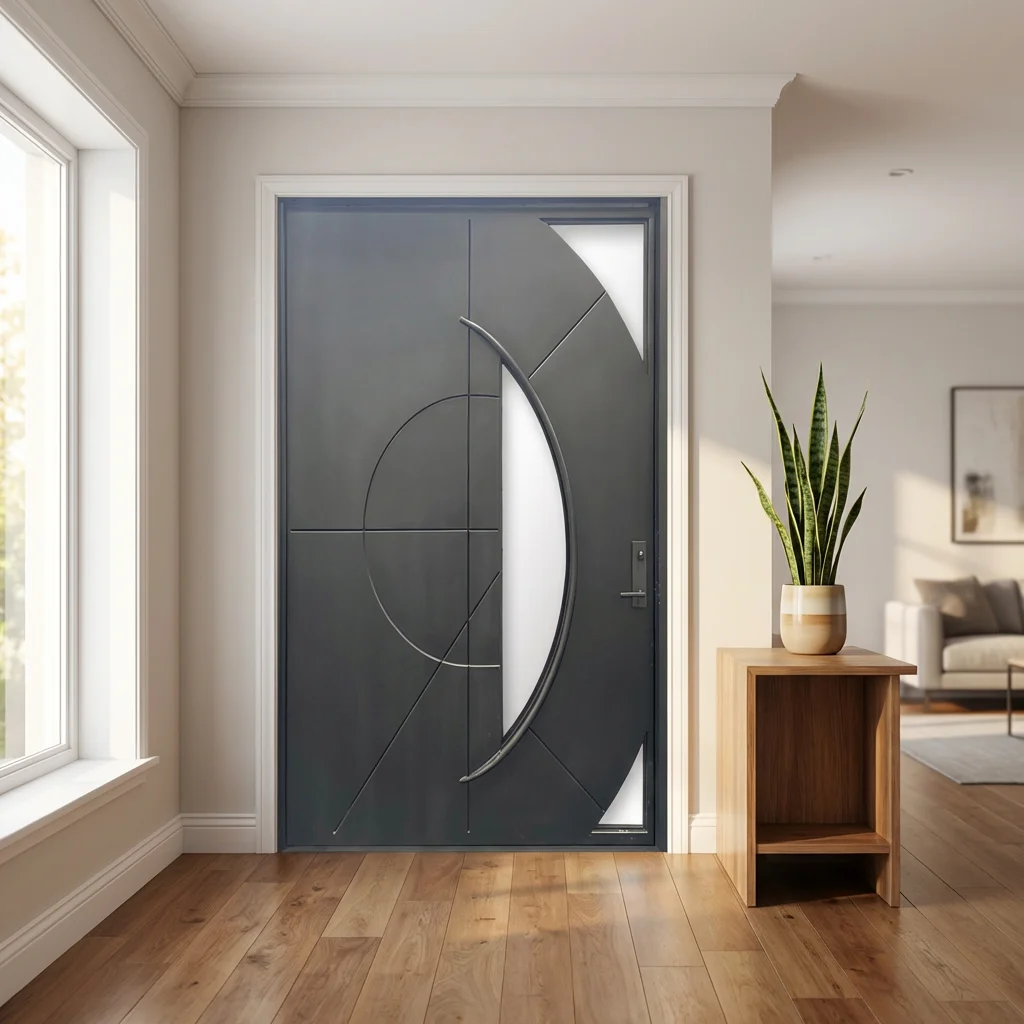
Walk into any recently completed boutique hotel, high-end retail space, or contemporary residential project, and chances are the entrance doesn’t swing on traditional hinges. More often than not, what catches the eye first is a tall, slender steel panel that rotates smoothly around a nearly invisible vertical axis. That’s the steel pivot door in action—and its growing presence across commercial and residential architecture isn’t accidental.
The pivot mechanism itself is simple: rather than side-mounted hinges, the door rotates on pins positioned at the top and bottom of the frame. This seemingly minor engineering difference unlocks a completely different visual language. Traditional hinged doors, by their nature, require clearance for the swing arc and reveal a visible knuckle—typically around 4.5 inches. Pivot doors, by contrast, operate with a much smaller profile, often reducing that visual interruption to roughly 1.5 inches. That reduction might sound trivial on paper, but in practice, it transforms how an entrance reads architecturally.
What makes steel the preferred material for this application comes down to a simple equation: strength-to-thickness ratio. Steel supports large, heavy panels without demanding bulky framing. That means cleaner sightlines, more glass, and less visual clutter. The result is a door that doesn’t just open and close—it frames a view, defines a threshold, and makes a deliberate architectural statement.
The shift toward pivot door systems isn’t just a design fad—there’s real market momentum behind it. The global pivot entry door market was valued at approximately $1.8 billion in 2024, with projections suggesting growth to around $3.4 billion by 2033. That represents a compound annual growth rate in the neighborhood of 7 percent. Within the broader door hinge and pivot category, the market is expected to move from roughly $2.15 billion in 2025 to about $3.2 billion by 2035.
What’s driving that growth? A few factors stand out. First, the demand for larger, more open interior spaces continues to push architects toward door systems that can handle oversized panels without compromising aesthetics. Second, the indoor-outdoor living trend—particularly visible in residential and hospitality projects—has created sustained interest in wide, unobstructed openings that pivot doors deliver naturally. Third, and perhaps most tellingly, steel doors are increasingly specified not just for front entrances but throughout buildings: wine rooms, interior partitions, home offices, and retail storefronts.
There’s a reason architects keep specifying pivot doors for projects where visual impact matters. The mechanism itself enables a cleaner, more contemporary appearance that traditional hinged systems simply can’t match. Because the pivot point sits at the top and bottom rather than the side, the door can be wider and taller without the structural compromises that would force bulkier framing.
This opens up design possibilities that were previously impractical. A 3.3-meter-high steel pivot door, for instance, can be engineered to withstand wind loads and heavy daily footfall while maintaining a minimalist aesthetic. The hardware stays concealed, the sightlines stay clean, and the entrance becomes a feature rather than an afterthought.
There’s also a functional dimension worth noting. Pivot doors distribute weight more evenly across the top and bottom pivot points, which means a large, heavy panel can be operated with surprisingly little effort. That smooth, balanced motion contributes to the sense of quality and precision that defines high-end architectural projects. It’s not just about how the door looks—it’s about how it feels to use.
None of this happens by accident. The performance of a steel pivot door depends heavily on the quality of its hardware, and the industry has established rigorous standards to ensure consistency. The ANSI/BHMA A156.4 standard, for example, covers door closers and pivots, establishing requirements for cycle testing, operational performance, closing force, and finish durability. Grade 1 door closers—the highest rating—must pass a two-million-cycle test on a door of specified weight. Pivots themselves are subject to similar durability requirements, matching that two-million-cycle benchmark.
For fire-rated applications, NFPA 80 adds another layer of requirements. The standard mandates specific quantities of pivots based on door height—a top and bottom pivot set with one intermediate pivot for doors up to 90 inches, and additional intermediate pivots for taller doors. Hardware used on labeled fire door assemblies must be listed by a nationally recognized testing laboratory.
These standards matter because they translate into real-world performance. A pivot certified to ANSI/BHMA A156.4 has been tested for corrosion resistance via salt spray testing to ASTM B117, ensuring that the architectural finish holds up over time. That kind of validation gives specifiers confidence that the door will perform as expected, year after year, in demanding environments.
A project in the southeastern United States illustrated these principles in a tangible way. A coastal mixed-use development required entrance doors that could withstand salt-laden air, heavy tourist foot traffic, and the occasional hurricane-force wind gust—all while maintaining the clean, modern aesthetic the developer had promised to tenants. Traditional hinged steel doors were considered, but the architect pushed for pivot systems to achieve the desired sightlines and scale.
The pivot doors specified for the project were fabricated with thermally broken steel profiles and dual-pane insulated glass, achieving thermal performance that met the local energy code without compromising the slim profile that made the design work. The hardware package was specified to ANSI/BHMA A156.4 Grade 1 standards, with corrosion-resistant finishes tested to ASTM B117. Three years into operation, the doors continue to operate smoothly, and the developer has since specified similar systems for two additional projects in the same region.
What made the difference? Attention to the details that don’t show up in renderings—proper pivot placement, adequate structural reinforcement, hardware that’s matched to the door’s weight and usage frequency. The architect noted that the pivot system’s ability to handle larger panels without visible hardware was what ultimately sold the client on the approach.
It’s worth being direct about this: pivot doors aren’t the right choice for every application. The mechanism introduces a small air gap at the base and around the pivot point, which can make them less effective for soundproofing and thermal insulation compared to well-sealed hinged systems. Hinged doors generally offer better sealing by default. For spaces where acoustic privacy or extreme thermal control is the top priority—recording studios, cold storage, or meeting rooms with sensitive audio requirements—a hinged door with perimeter seals may be the better technical choice.
Pivot doors also require more precise installation than standard hinged systems. The hardware is less standardized, and the structural framing needs to accommodate the top and bottom pivot points accurately. Field adjustments are more difficult, and mistakes during installation can lead to sagging or operational issues over time.
That said, for applications where visual impact, scale, and clean sightlines are the driving factors, the pivot door offers capabilities that hinged systems can’t match. The ability to handle larger and heavier panels with a slimmer profile makes them the default choice for grand entrances, luxury residential projects, and commercial spaces where the entrance itself is part of the brand experience.
The sleek appearance of a steel pivot door isn’t just about the design—it’s about the fabrication. Steel profiles need to be precision-cut, welded, and finished to tight tolerances. The hardware pockets must be accurately positioned. The finish—whether powder-coated, primed for field painting, or left with a natural patina—needs to be applied consistently to avoid visible imperfections.
Companies that specialize in this work, like Xiamen SenYi Ironware, have developed the production capabilities to handle these requirements at scale. The combination of in-house fabrication, quality control processes, and experience with international specifications allows them to deliver steel pivot door systems that meet both aesthetic and performance expectations. For architects and developers sourcing from overseas, that manufacturing expertise translates into consistency—the assurance that what’s specified on paper matches what shows up on site.
 Hot News
2026-10-19
2026-10-12
2026-10-07
2026-09-25
2026-09-17
2026-09-11

Xiamen SenYi is a professional enterprise specializing in the research, design, production and sales of high-quality iron doors. It is dedicated to providing customized iron door that combine safety, practicality and aesthetic value for various customers.
No. 1043, Yincheng Mingzhu, Tong'an District, Xiamen City, Fujian Province, China
Copyright © 2025 by Xiamen SenYi Ironware Co., Ltd Privacy Policy
 EN
EN