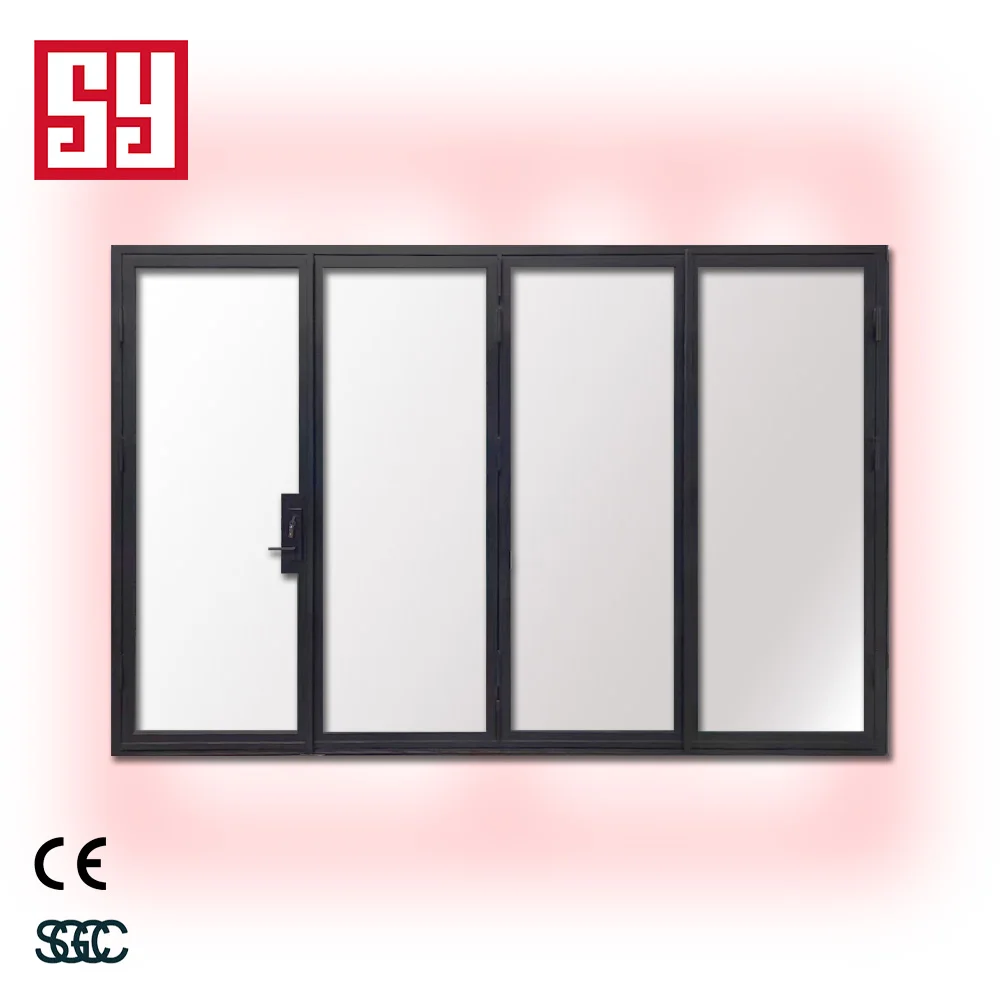
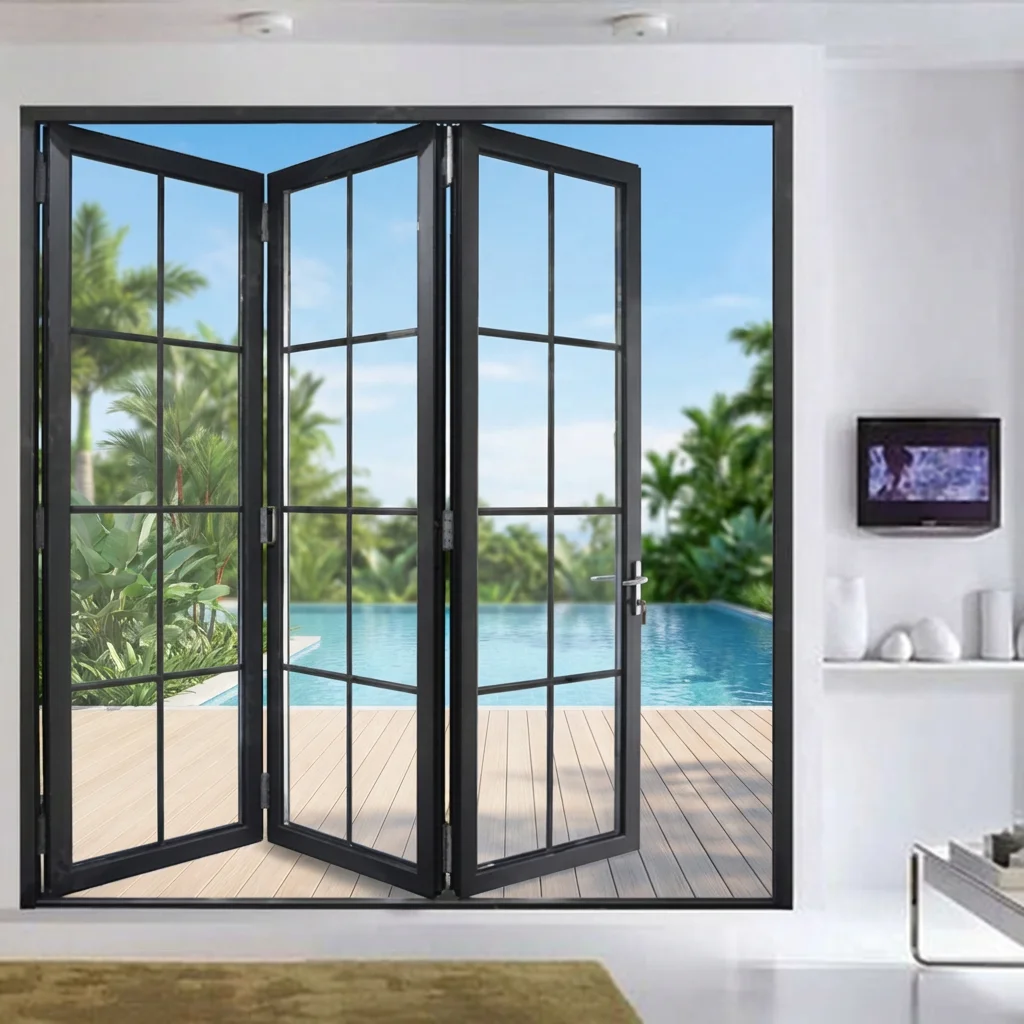
Anyone who has spent time managing a commercial space knows that square footage is precious. Every square foot that gets eaten up by a door's swing radius is square footage that could be holding merchandise, seating customers, or keeping traffic lanes clear. Steel sliding doors solve this problem by moving parallel to the wall, taking up no more space than the thickness of the panel stack when open.
In commercial settings—retail stores, restaurants, office lobbies, and mixed-use developments—the ability to maximize usable floor space directly impacts the bottom line. A door that swings inward consumes floor space that could otherwise generate revenue. A door that swings outward creates hazards for pedestrians on sidewalks or in corridors. Sliding doors eliminate both problems. They operate within the plane of the wall, requiring no clearance for a swing arc. This is not a minor convenience. In high-traffic commercial environments, every inch of clear floor space matters.
Commercial spaces are tough on doors. Shopping carts get bumped into them. Merchandise displays get moved in and out. Delivery personnel push through with hand trucks. In climates with freeze-thaw cycles, wood doors will warp and stick within a few seasons. Aluminum can dent and lose its true alignment.
Steel handles the abuse differently—it flexes under impact and returns to shape rather than deforming permanently. This matters in commercial settings because downtime for door repairs means lost business. A broken door at a retail entrance during peak hours is not just an inconvenience; it is a revenue problem.
Steel is approximately three times stronger than aluminum, which allows for significantly slimmer frame profiles while maintaining structural integrity. That slimness matters in commercial settings because it means more glass area for natural light without sacrificing security or wind load resistance. For storefronts, restaurants, and office buildings, this translates into brighter, more inviting spaces that attract customers and improve the work environment.
Commercial spaces are famously hard to heat or cool, and they are often noisy. Steel sliding doors, when properly insulated with thermal breaks and weather stripping, achieve thermal performance that rivals fixed wall sections. The multi-panel design allows for continuous sealing along each sliding joint, cutting down on air infiltration.
Acoustic separation is another area where steel doors shine. The mass of steel panels, combined with sealed joints, reduces sound transmission much more effectively than lighter materials. A manufacturing facility producing heavy machinery found that switching from fabric curtains to insulated steel doors cut noise bleed by twelve decibels. That took the office space from uncomfortably loud to perfectly acceptable without needing extra acoustic treatments.
For commercial facilities that need to maintain consistent temperatures or protect workers and customers from excessive noise, the thermal and acoustic performance of steel sliding doors delivers real benefits that show up on utility bills and satisfaction surveys alike.
| Consideration | Steel Sliding Doors | Wood Swing Doors | Aluminum Sliding Doors |
|---|---|---|---|
| Floor Space Required | Minimal | Full swing radius | Minimal |
| Impact Resistance | Excellent | Poor | Moderate |
| Thermal Break Available | Yes | N/A | Yes |
| Acoustic Performance (STC) | Up to 55+ | 25–30 | 30–35 |
| Maintenance Frequency | Low | High | Moderate |
Commercial properties house valuable inventory, expensive equipment, and sometimes sensitive data or materials. Security is not optional. Steel sliding doors provide a level of physical protection that other materials simply cannot match. They resist kicking, prying, and forced entry attempts far better than wood or aluminum alternatives.
The sliding mechanism itself adds a layer of security that swing doors lack. When closed, sliding doors are locked into a track system that makes them difficult to force open from the outside. Multi-point locking systems can be integrated into the door assembly, distributing securing forces across multiple points along the door's height.
For retail stores with high-value merchandise, restaurants with expensive equipment, or office buildings with sensitive information, this security advantage is not a nice-to-have. It is a fundamental requirement. And unlike some security measures that compromise usability, steel sliding doors maintain full accessibility when open while providing robust protection when closed.
One of the most overlooked advantages of steel sliding doors in commercial spaces is the maintenance picture. Commercial facility managers are busy people. They do not have time to sand, paint, and seal doors every season. They do not want to deal with warped frames, stuck tracks, or hardware that fails prematurely.
Steel sliding doors, with proper finishes and quality hardware, require minimal ongoing attention. The powder-coated finishes that are standard on quality steel doors resist fading, chipping, and corrosion. The sliding tracks, when properly designed, shed debris rather than collecting it. The hardware components—rollers, guides, and locks—are built to withstand the cycles that commercial use demands.
The service life of a well-maintained steel sliding door in a commercial setting typically exceeds twenty years under normal conditions. That is not a sales pitch. It is what facility managers see in their maintenance logs year after year. When the cost of replacement and the disruption of installation are factored in, the long-term value proposition of steel becomes even more compelling.
Steel sliding doors are particularly well-suited to certain commercial applications. They excel in:
Retail storefronts where visibility, security, and traffic flow are priorities
Restaurant entrances and patios where durability and weather resistance matter
Office buildings where space efficiency and acoustic performance are valued
Mixed-use developments where the doors must perform across multiple use cases
Warehouse and distribution center entries where large openings and heavy use are the norm
They are less ideal for applications where the opening is extremely wide and ceiling height is limited, where folding configurations might be more appropriate. They also require a clear wall space on at least one side to accommodate the stacked panels when open—though this requirement is modest compared to the swing radius of traditional doors.
Steel sliding doors are a proven solution for commercial spaces that demand performance, durability, and low maintenance. Companies like SenYi have built their manufacturing capabilities around meeting these demands for international clients, with a focus on quality control and reliable supply chain execution.
 Hot News
2026-10-19
2026-10-12
2026-10-07
2026-09-25
2026-09-17
2026-09-11

Xiamen SenYi is a professional enterprise specializing in the research, design, production and sales of high-quality iron doors. It is dedicated to providing customized iron door that combine safety, practicality and aesthetic value for various customers.
No. 1043, Yincheng Mingzhu, Tong'an District, Xiamen City, Fujian Province, China
Copyright © 2025 by Xiamen SenYi Ironware Co., Ltd Privacy Policy
 EN