Wrought iron has a carbon content so low it barely registers on most mill certifications, usually under 0.08 percent. That low carbon is the whole story behind its behavior. It is soft enough to forge, bend, and twist at relatively low temperatures, which is exactly why decorative work has relied on it for centuries. A blacksmith can taper a bar, roll a scroll, or split a bar into two matching branches without the metal cracking. Mild steel can be forged too, but it fights back more, and cast iron cannot be forged at all. Cast iron is poured into a mold, and the result is brittle. Hit a decorative cast iron panel and it may chip or shatter. A wrought iron element bends and holds its shape.
The slag content matters as well. Traditional wrought iron carries fibrous slag inclusions that give it a grain, similar in concept to wood grain. That grain is part of why aged wrought iron develops a layered, almost weathered look rather than a uniform rust film. Modern decorative ironwork is usually made from mild steel because genuine wrought iron is scarce and expensive, but the forging and finishing techniques are inherited from the wrought iron tradition. That distinction is worth knowing before specifying anything.
A machined steel plate is flat and uniform. A hand-forged scroll is not. The hammer marks, the slight taper, the way a twist compresses the metal, all of that creates surface variation that catches light differently across the piece. That variation is the decorative value. It is also the reason two doors built from the same drawing never look identical. Each one carries the mark of the person who worked it.
Decorative ironwork also solves a design problem that plain panels cannot. A large flat surface reads as blank. A field of scrollwork, a grid of bars with hand-forged nodes, or a central medallion gives the eye something to travel across. In entry doors, gates, and interior partitions, that visual structure can carry the whole composition. The same opening with a plain flush panel would need artwork or another element to hold attention. The ironwork does that job on its own.
Iron and steel rust. There is no version of this material that ignores moisture forever. The defense is the finish system, and the finish system is only as good as the preparation underneath it. A decorative door with intricate scrollwork has dozens of recesses, inside corners, and tight overlaps where moisture can sit. If those areas are not cleaned, primed, and coated properly, rust starts in the crevices and works outward. By the time it shows on the surface, the damage is already under the coating.
Abrasive blast or wire brush the entire piece to remove mill scale, rust, and oil.
Apply a zinc-rich primer to bare metal, especially in recessed areas and weld zones.
Build a compatible topcoat system, usually a polyurethane or polyester powder coat.
Inspect the coating on tight overlaps, since these are the first places to fail.
Hot-dip galvanizing is another option for exterior work. It sacrifices a zinc layer to protect the steel, and it reaches into recesses that spray coatings miss. The tradeoff is the surface texture. Galvanizing can leave a rougher finish that shows through thin topcoats. For a decorative piece where the surface matters, that has to be planned for.
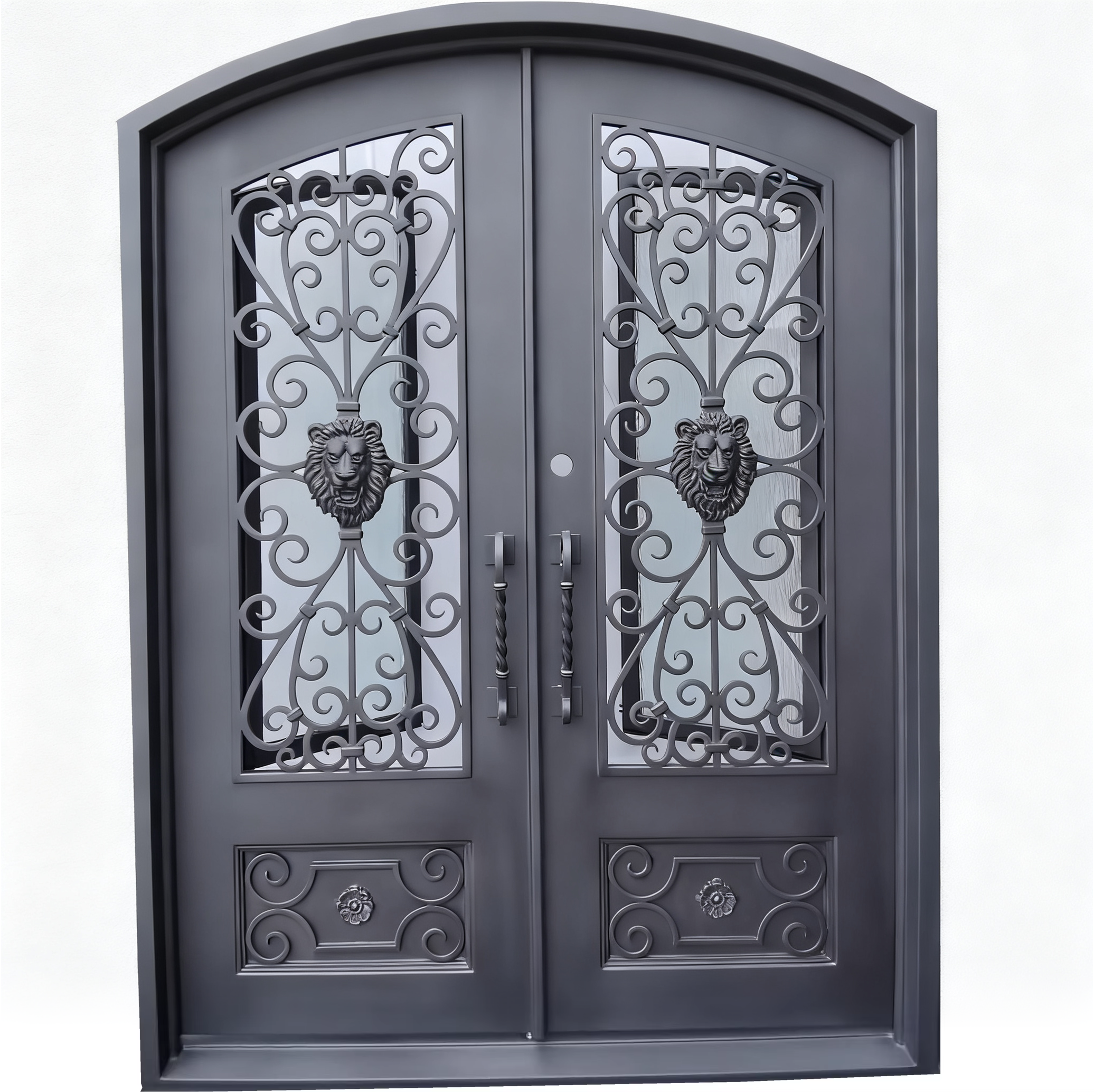
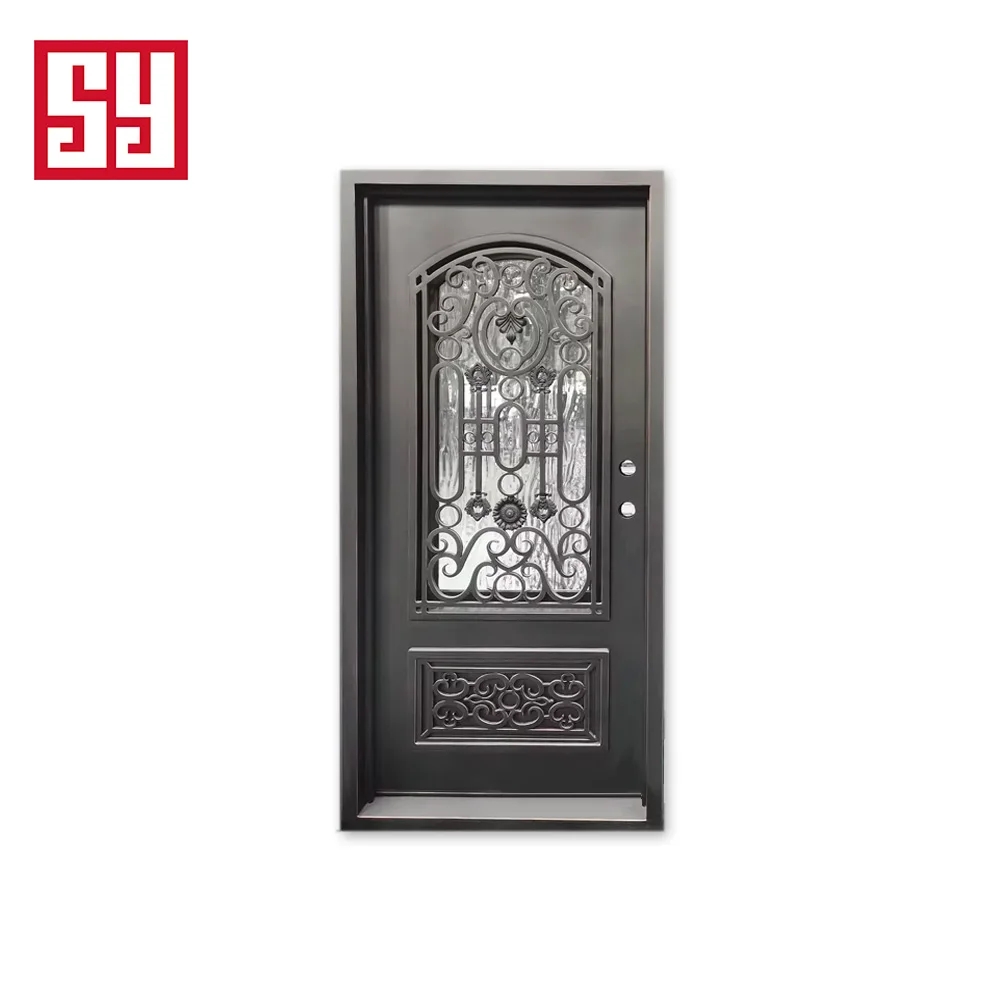
A recent hospitality project on the U.S. East Coast involved a set of custom entry doors for a boutique hotel. The design called for a wrought iron door panel with a central medallion and a perimeter of hand-forged scrollwork, set into a steel frame with glass behind the ironwork. The piece was exterior facing, so it had to handle weather as well as look right.
The fabrication team built the scrollwork as separate forged elements and assembled them onto a frame rather than machining the pattern from a single plate. That choice mattered for two reasons. Forging the scrolls individually allowed tighter curves and more natural transitions than a machined pattern would have produced. It also made the finishing more reliable, because each element could be cleaned and coated before assembly, with touch-up applied to the weld joints afterward.
The doors were specified with a zinc-rich primer and a polyester powder topcoat, and the assembly was tested for air and water performance. That last step is worth noting. Decorative ironwork can look beautiful and still fail as a door if the frame, seals, and hardware are not designed together. In this case the ironwork was decorative, but the door assembly still had to meet the same performance expectations as any other exterior entry.
| Attribute | Decorative wrought iron | Machined steel panel | Cast iron |
|---|---|---|---|
| Formability | High, forgeable | Moderate, needs heat | None, cast only |
| Surface detail | Hand-forged variation | Uniform, tool marks | Molded, repeats |
| Impact behavior | Bends, holds shape | Bends | Can chip or crack |
| Repair approach | Weld and reforge | Weld and grind | Difficult, often replaced |
| Typical use | Entry doors, gates, railings | Modern panels, frames | Ornamental castings |
Decorative ironwork is not the right answer for every opening. A tight budget and a plain design brief do not need hand-forged scrollwork. A high-traffic commercial door that gets abused daily may be better served by a simple, robust panel that is easy to repair. And a project that cannot commit to periodic maintenance should think carefully before choosing an exterior decorative piece. The finish will eventually need attention, especially in coastal or polluted environments.
There is also a practical limit to how much decorative detail can be packed into a door and still have it function. Deep recesses collect water and dirt. Complex patterns take longer to clean and coat. Every design decision that adds visual richness also adds a maintenance obligation. The projects that hold up best are the ones where the decorative elements are designed with drainage, cleaning access, and coating coverage in mind, not added as an afterthought.
Xiamen SenYi Ironware Co., Ltd. (SenYi) produces steel and iron door hardware and frame systems, including decorative assemblies that need consistent fabrication tolerances and finish quality. The company's production process covers forming, welding, surface preparation, and coating, which is where decorative ironwork either holds up or fails. For projects that combine ornamental detail with exterior performance requirements, working with SenYi's engineering team during design can help match the decorative intent to the structural and finishing realities.
 Hot News
2026-10-26
2026-10-22
2026-10-19
2026-10-12
2026-10-07
2026-09-25

Xiamen SenYi is a professional enterprise specializing in the research, design, production and sales of high-quality iron doors. It is dedicated to providing customized iron door that combine safety, practicality and aesthetic value for various customers.
No. 1043, Yincheng Mingzhu, Tong'an District, Xiamen City, Fujian Province, China
Copyright © 2025 by Xiamen SenYi Ironware Co., Ltd Privacy Policy
 EN