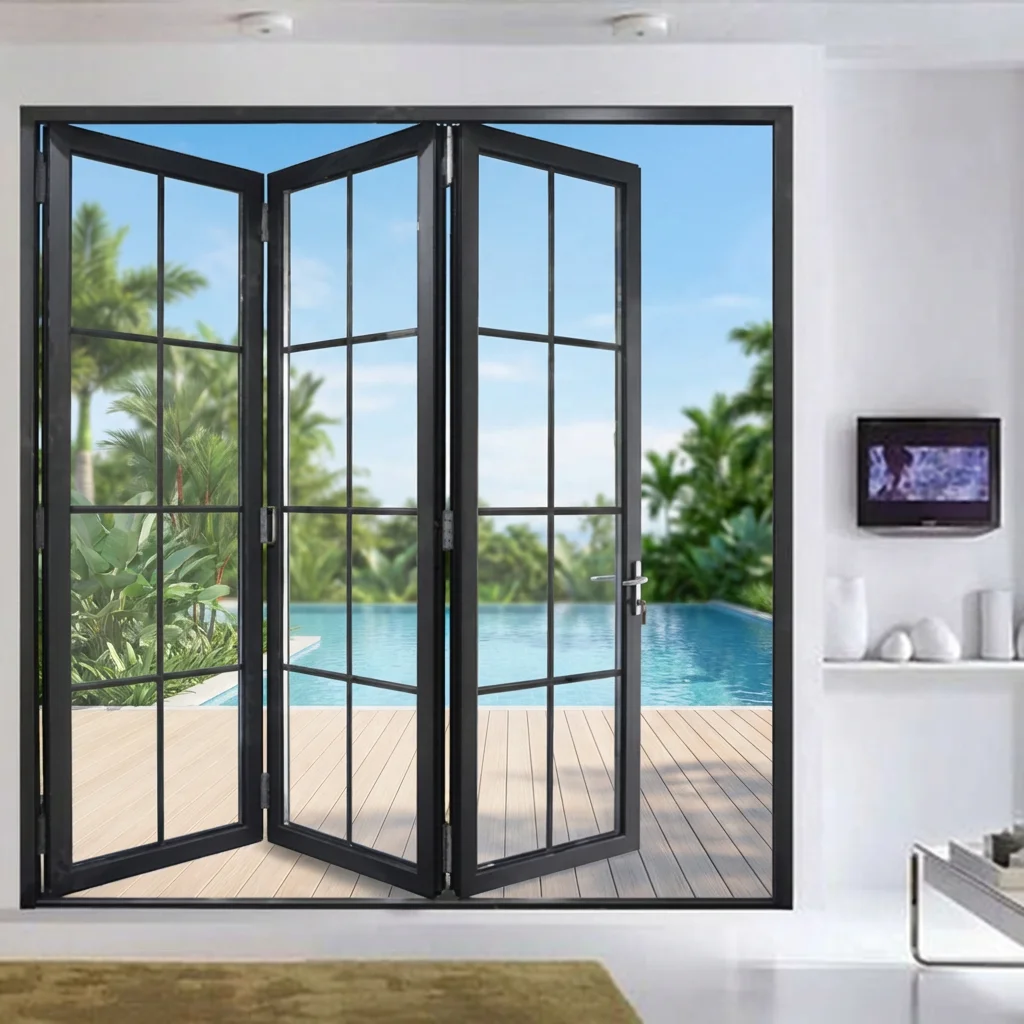
An exterior door deals with wind load, driving rain, UV, temperature swings, salt air, and pollution. All at once. Interior doors live in a controlled box. A west-facing entry in a coastal climate sees surface temperatures that swing between day and night, and moisture that sits in every crevice. Wrought iron doors handle that environment better than expected, but the reason is not just the metal. It is the combination of material behavior, structural depth, and a finish system built for exposure.
Steel and iron have a high modulus of elasticity, around 200 GPa. That stiffness keeps a panel from deflecting under wind load, which protects seals and frame joints. A panel that flexes opens gaps at the corners, and once water gets into the frame, problems start. The material also has a thermal expansion coefficient around 12 µm/m°C, roughly half that of aluminum. Less movement between frame and wall means fewer seal failures.
Walk through a commercial district and look at exterior doors that have been in service for decades. Wood ones show rot at the bottom rail. Aluminum ones often have dents at the push side. Cast iron decorative panels may have chips or cracks. A wrought iron or steel door takes impact differently. The metal bends. It does not shatter. A dented steel door can be straightened, welded, and refinished. A cracked cast iron panel usually gets replaced.
That repairability is a real asset outdoors. A door repaired on site stays in service. A door replaced disrupts the building and costs more. The same property helps with security. A steel frame with multi-point locking resists forced entry far better than hollow-core wood or thin aluminum. For an exterior entry, that combination of impact resistance and rigidity is hard to beat.
| Attribute | Wrought iron or steel door | Wood exterior door | Aluminum exterior door |
|---|---|---|---|
| Impact behavior | Bends, can be repaired | Cracks, rots | Dents, can be repaired |
| Thermal expansion | About 12 µm/m°C | Varies with moisture | About 23 µm/m°C |
| Structural stiffness | High | Moderate | Moderate |
| Corrosion risk | High, needs finish | High, needs finish | Low, but galvanic risk |
| Repair approach | Weld, grind, refinish | Replace sections | Replace sections |
Iron and steel rust. That is not a flaw that can be engineered away. The defense is a coating system that keeps moisture and oxygen off the metal. For exterior use, preparation matters as much as the coating. A decorative door with scrollwork and recesses has many places where water can sit. If those areas are not blasted clean and primed properly, rust starts under the coating and pushes it off from the inside.
Hot-dip galvanizing is one of the most reliable approaches for exterior steel. The process immerses the fabricated assembly in molten zinc, and the zinc becomes a sacrificial layer. ASTM A123 covers zinc coatings on iron and steel products, including minimum thicknesses for different material categories. A galvanized layer corrodes before the steel does, buying time in coastal or industrial environments. The tradeoff is surface texture. Galvanizing can leave a rougher finish, which has to be planned for if the topcoat is thin.
Powder coating or a liquid topcoat goes over the primer or galvanizing. For exterior work, a polyester or fluoropolymer topcoat holds color and gloss longer than basic enamel. The coating system should be tested for adhesion and salt spray. ASTM B117 is the standard salt spray test, and while it does not perfectly predict field performance, it gives a comparison point. A door with a longer salt spray result is not guaranteed to survive every coastal installation, but it starts from a better place.
A beautiful door panel with a poor threshold will leak. That pattern shows up over and over in exterior installations. The leaf gets all the attention, but weather performance depends on the perimeter. The threshold has to shed water away from the opening. Jamb seals have to compress evenly. The bottom sweep has to make contact without dragging. On a heavy iron door, hardware also carries more weight than a typical residential door, so hinges or pivots need to be sized accordingly.
The relevant performance standard in North America is AAMA/WDMA/CSA 101/I.S.2/A440. It rates door assemblies for air infiltration, water penetration, and structural wind load. A rating such as CW PG50 or CW PG60 indicates a design pressure suitable for exposed locations. The rating applies to the whole assembly, not just the panel. Frame, seals, hardware, and installation details all contribute. A door tested to a high rating can still fail if the threshold drains toward the interior or a seal is pinched during installation.
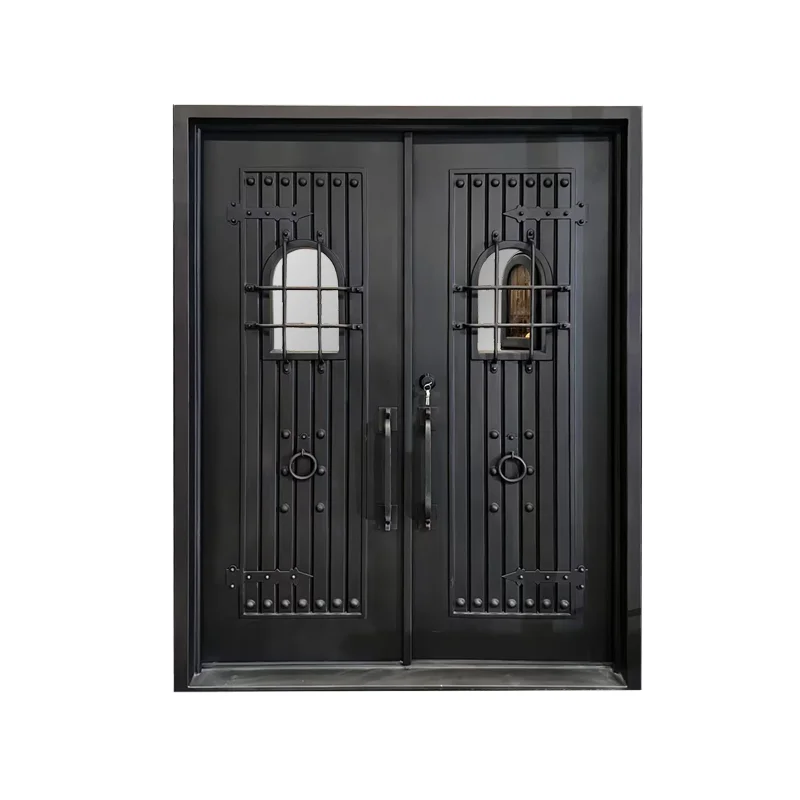
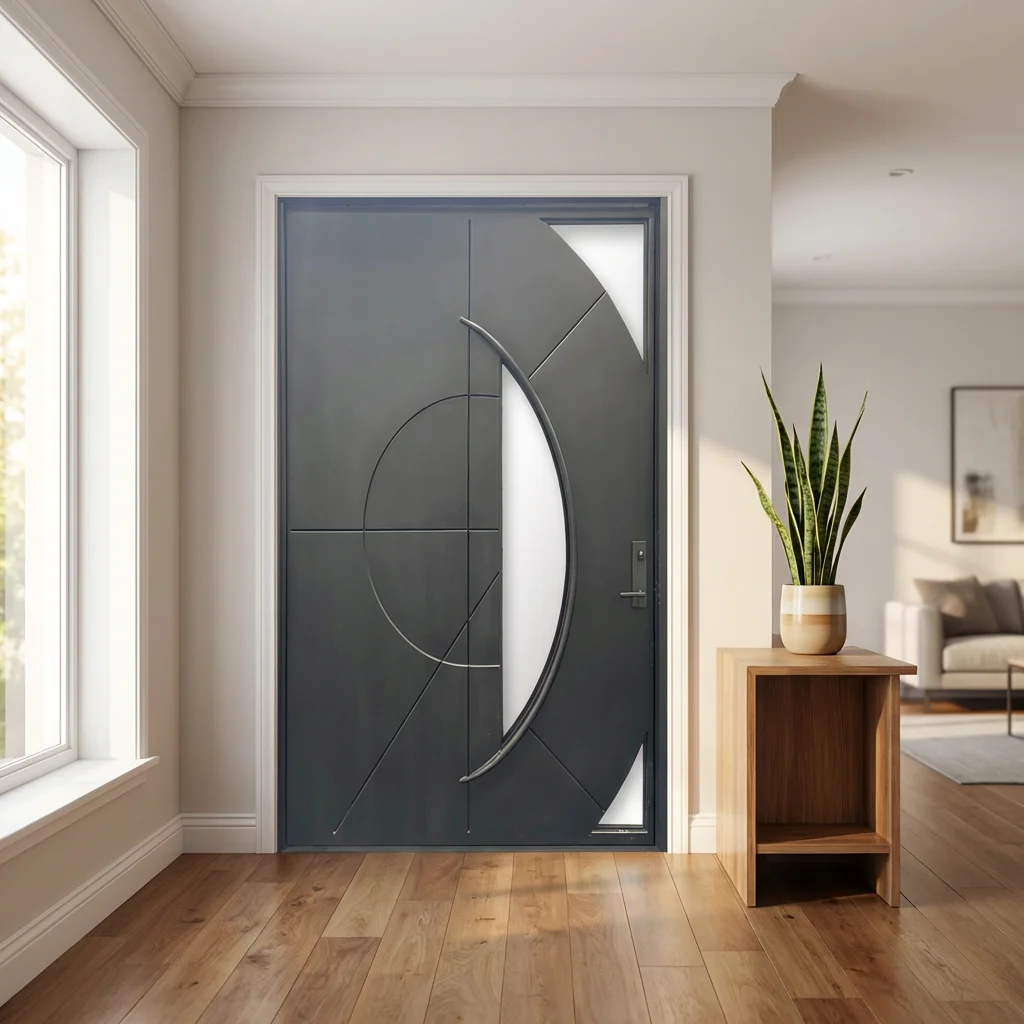
A recent project on a coastal residential property made this clear. The entry door was a custom wrought iron design with glass panels and a decorative lower panel. The panel itself was galvanized and powder coated. During the first rainy season, water showed up at the interior floor. The panel was fine. The problem was the threshold. The original sill was shallow and the seal did not compress at the corners. The fix was a new threshold with a raised sill, a better drainage path, and adjustable corner seals. The lesson is simple. On an exterior door, the panel is only one part of the system.
Decorative ironwork adds beauty and risk. Every recess, overlap, and upward-facing pocket can hold water. A design that looks great in a shop drawing can trap moisture in ways that are hard to see until rust appears. The fix is to design decorative elements with drainage in mind. Avoid upward-facing cups. Drill small weep holes in the bottoms of enclosed sections. Make welds continuous so water cannot enter a hollow tube.
Orient scrolls and leaves so water runs off rather than pooling.
Add weep holes at the lowest point of any enclosed decorative element.
Use continuous welds on exterior assemblies to keep water out of hollow sections.
Ensure the coating reaches inside recesses, which may require spraying before assembly.
None of this is complicated, but it has to be decided during design. Adding a weep hole after fabrication is possible. Redesigning a scroll so it does not collect water is harder. The best exterior ironwork is designed by people who understand both the aesthetic and the drainage.
Wrought iron doors are a strong choice for exterior entry doors, gates, and partitions where security, durability, and appearance all matter. They are not the cheapest option, and they are not the lightest. A heavy iron door requires a solid frame, adequate structural support, and hardware that can handle the weight. In a retrofit, that can mean reinforcement. In new construction, it is easier to plan for.
They are also not maintenance-free. Any exterior steel door needs periodic inspection and touch-up. Coastal environments accelerate the schedule. A project that cannot commit to that maintenance should consider a different material or accept that appearance will degrade. The honest answer is that iron doors work well outdoors when the finish system, hardware, and drainage details are designed as a package. When any one of those is treated as an afterthought, the door becomes a source of problems.
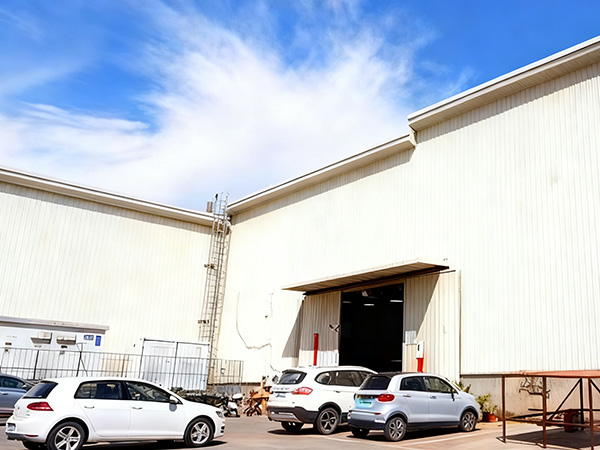
Xiamen SenYi Ironware Co., Ltd. (SenYi) manufactures iron and steel door hardware and frame systems for exterior applications, with production processes that cover forming, welding, galvanizing coordination, and coating. The details that keep an exterior iron door performing, such as continuous welds, drainage paths, and consistent coating coverage, are controlled at the fabrication stage. For projects that need a decorative exterior door with reliable weather performance, SenYi's engineering support can help align the design with the fabrication and finishing requirements.
 Hot News
2026-10-26
2026-10-22
2026-10-19
2026-10-12
2026-10-07
2026-09-25

Xiamen SenYi is a professional enterprise specializing in the research, design, production and sales of high-quality iron doors. It is dedicated to providing customized iron door that combine safety, practicality and aesthetic value for various customers.
No. 1043, Yincheng Mingzhu, Tong'an District, Xiamen City, Fujian Province, China
Copyright © 2025 by Xiamen SenYi Ironware Co., Ltd Privacy Policy
 EN